The American Heritage Songs Project

#64 Shenandoah

La Citta Vita. (2010, December 17). Shenandoah River, aerial. Flickr. Licensed under CC BY-SA 2.0.
Sheet Music & Lesson Plan
with additional resources
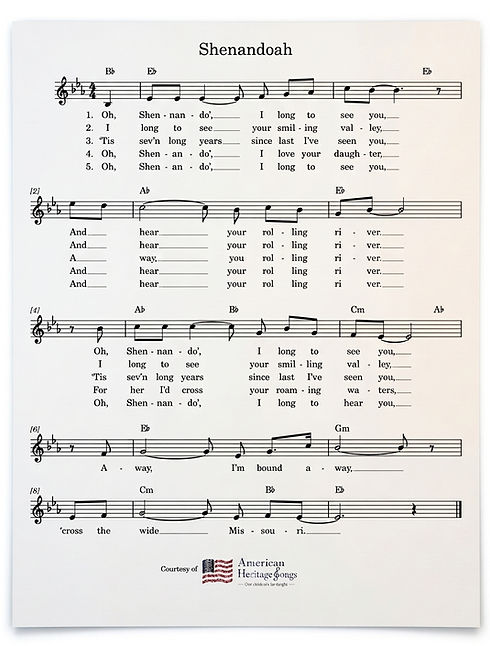
Sheet Music -
Lead Sheet in Eb Major
Lesson Plan
In the works!
Video: A lovely performance of James Erb's 1975 arrangement by the UNT A Cappella Choir, conducted by Allen Hightower.
University of North Texas College Concerts. (2018, July 5). UNT A Cappella Choir: Shenandoah. [Video]. YouTube. https://youtu.be/m8yBPMrlz9w?si=xfaasOaUFhGwbNzw
Video: Another lovely a cappella rendition. VOCES8 performing the Hewitt-Jones arrangement.
University of North Texas College Concerts. (2018, July 5). UNT A Cappella Choir: Shenandoah. [Video]. YouTube. https://youtu.be/m8yBPMrlz9w?si=xfaasOaUFhGwbNzw
Video: Upbeat arrangement of Shenandoah.
The Petersens. (2023, October 6). Shenandoah - The Petersens (LIVE). [Video]. YouTube. https://youtu.be/YK4Ndt4uqlE?si=HaxOOP6Q362CmZ9p
Go back in time . . .
Here is a snapshot of how the song, "Shenandoah" was known and taught in some 1913 American schools. Included is a link to the entire book: Whall, W. B. (1913). Ships, sea songs and shanties (3rd ed., enlarged; illustrations by V. Whall). James Brown & Son.


“Shenandoah” (1913). Illustration by Veronica Whall, from W. B. Whall's Ships, Sea Songs and Shanties, pp. 1–3. Smithsonian Libraries and Archives.
Go further back . . . how about 1882?!
It is interesting to read about how different people
at different times perceived and shared
the song's origins and development.

References
Dowd, D. R. (1992). War under heaven: Pontiac, the Indian nations, and the British empire. The John Hopkins University Press.
Gilbert, R. (2005). Sailor songs and sea shanties: Maritime music of the 19th century. Routledge.
Green, R. (2009). The Shenandoah Valley: An illustrated history. The History Press.
Hale, A. D. (2007). Songs of the fur trade: Music of the voyageurs. University of Minnesota Press.
Knapp, S. (2010). American folk music: A regional exploration. Oxford University Press.
Lytle, L. (1989). Indian captivity narratives: The stories of those who were taken. University of Chicago Press.
Bingham, G. C. (1845). Fur traders descending the Missouri [Oil on canvas]. The Metropolitan Museum of Art, New York, NY. https://www.metmuseum.org/art/collection/search/10159
Unknown. From the public domain U.S. Naval Historical Center: https://www.history.navy.mil/content/history/nhhc/our-collections/photography/numerical-list-of-images/nhhc-series/nh-series/NH-85000/NH-85964.htmlOriginally uploaded to EN Wikipedia as en:File:CSSShenandoah.jpg by en:User:McMullen 19 November 2004., Public Domain, https://commons.wikimedia.org/w/index.php?curid=7860376
Unknown. (ca. 1840s). Skenando: An Oneida chief who remained friendly to the United States [Hand-colored lithograph]. Six Nations Public Library. https://www.snpl.ca
Song Background
What is the song about? Really.
Several theories about the meaning of the song, "Shenandoah" are presented here. You decide.
Theory 1 - Shenandoah River/Valley

By AgnosticPreachersKid - Own work, CC BY-SA 4.0, https://commons.wikimedia.org/w/index.php?curid=36374115
The song is about the Shenandoah River and Shenandoah Valley in Virginia and West Virginia. The lyrics express a longing for the beauty and peacefulness of the river or the valley, missed by early settlers and travelers during their journeys.
"The Shenandoah Valley, with its lush landscapes and winding river, has long captured the imagination of those who settled there, making it a natural symbol of both beauty and yearning for those far from home" (Green, 2009, p. 52).
Theory 2 - Chief Skenandoa

Image courtesy of Six Nations Public Library
(c. 1840s).
Does the name "Shenandoah" refer to the Oneida Chief? "Skenandoa, a leader of the Oneida Nation, played a pivotal role in the American Revolution, choosing to side with the American colonists against the British, an act that led to immense sacrifices for his people" (Dowd, 1992, p. 118).
There is no direct evidence linking the song to John Skenandoa, he did fight "seven long years" in the Revolutionary War.
Theory 3 - The Song as a Sea Shanty (Ship Theory)

By photographer not identified - From the public domain U.S. Naval Historical Center:
"Folk songs like 'Oh Shenandoah' were often adapted by sailors who used them to express their longing for distant shores, particularly when they found themselves separated from loved ones during long voyages" (Gilbert, 2005, p. 87).
Several vessels were named, 'Shenandoah.' The ship pictured was the CSS Shenandoah, a Confederate raider during the American Civil War.
Some believe the song was adopted by these sailors, as a sea shanty; the rhythm of the song matched the motions required to hoist the sails.
Theory 4 - Native American Love Story
(Trader & Chief's Daughter)

Bingham, G. C. (1845). Fur traders descending the Missouri [Oil on canvas].
Could "Shenandoah" be the song of a love story?
"The colonial period was marked by complex relationships between European settlers and Native American tribes, and the theme of forbidden love, often between a trader and a chief's daughter, played out in the cultural myths of the time" (Lytle, 1989, p. 230).
Theory 5 - A Folk Song of the Fur Trade

By aimee castenell - Flickr: missouri river, CC BY-SA 2.0, https://commons.wikimedia.org/w/index.php?curid=18058625
Was the song sung about the Shenandoah Valley in Virginia while the fur traders were working out west?
"Fur traders, traveling along the Missouri River, often sang ballads like 'Oh Shenandoah' to pass the time, with the song's lyrics reflecting their homesickness and longing for the familiarity of the land they had left behind" (Hale, 2007, p. 142).
Did the song originate with the fur traders along the Missouri River in the early 19th century?
OR . . .
Theory 6 - The Song has an Evolving Origin
Because the song was passed down orally and adapted by different communities (especially during the time of Westward Expansion), the meaning and origin of "Oh Shenandoah" could have evolved over time.
As the song spread, new lyrics and versions were created, each possibly reflecting the emotional experiences of the singers, such as nostalgia, longing, or search for cultural identity in foreign parts of a country -- new to them.
"As folk songs like 'Oh Shenandoah' were passed from one generation to the next, their meanings shifted, reflecting the lives of those who sang them and the times in which they lived" (Knapp, 2010, p. 193).

American Heritage Songs

About
American Heritage Songs
Few 21st century American school children can sing by heart, let alone, recognize, traditional American children's songs. Why? Because fewer teachers are teaching the songs of our American heritage in school. In 2003, Dr. Marilyn Ward addressed the problem by identifying the 84 songs most regularly taught in American schools, and most well known by our, 19th-20th century, populous. [1]
The purpose of The American Heritage Songs Project is to provide parents and teachers with the songs and tools for passing on our national treasure to our children. Folk songs of America are a large part of our children's birthright. By knowing American Heritage Songs, we can better understand who we are, where we are, and from whom and whence we came. "Music is a symbolic means of expression woven through the strands of human experience we label as history" (Barret, McCoy, and Veblen. 1997).
[1] Ward, M. (2003). The extent to which American children’s folk songs are taught by general music teachers throughout the United States at the beginning of the 21st century. In The extent to which American children’s folk songs are taught by general music teachers throughout the United States at the beginning of the 21st century.

The List
84 American Heritage Songs
Download your copy
84 American Heritage Songs


It is hoped . . .
our children will be taught to sing - the songs sung by Americans and their children for centuries - the songs of our heritage. These are songs that can provide our children a sense of who they are as American citizens, because they give us insight into our past and help us look to our future.
The 84 Songs identified as core to our American Heritage are given that status because they have continued to be part of the memory and knowledge of our people, and also, because they have been taught in our schools for centuries
(until the most recent decades). American Heritage songs are such because through them we can connect with what is praiseworthy in our tradition. These songs have been instrumental in shaping the good women and men of our country for years.
As we repair, maintain, and preserve our constitutional republic, it behooves us to provide our children with their cultural heritage.
The good music of our heritage gives us
a deeper understanding of
what it means to be citizens of
The United States of America.
The goodness in American culture is our birthright.


